

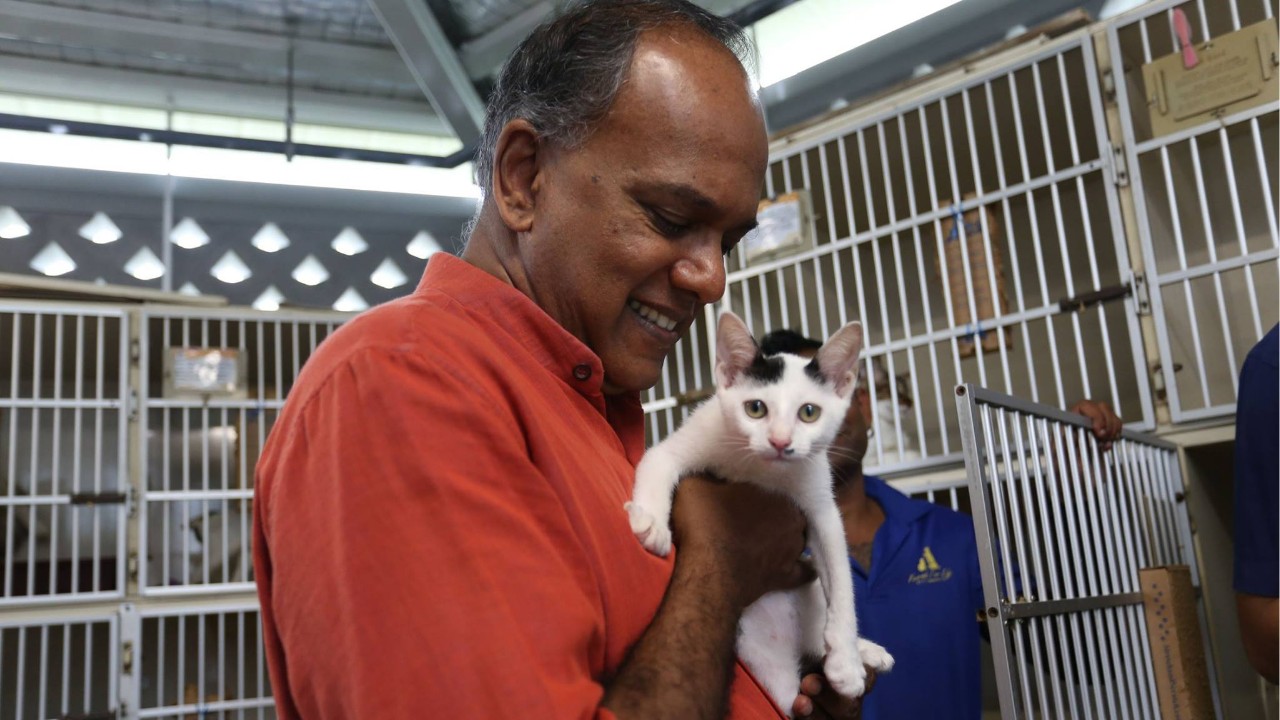
Singapore is getting serious about animal cruelty. Minister for Home Affairs and Coordinating Minister for National Security K Shanmugam has made it clear that the government has zero tolerance for anyone who deliberately harms animals.
His comments came after a string of disturbing cat deaths in places like Yishun, Punggol and Tampines earlier this year. Even though investigations by the National Parks Board (NParks) found that three of the cases were likely accidents involving vehicles, public concern was very strong.
At the time, Mr Shanmugam, who is also a Member of Parliament for Yishun, said on Facebook:
“This is not who we are as a people.”
Recently, a man who was caught throwing cats from HDB blocks had his jail term doubled after prosecutors appealed. This case is just one example of how seriously the government is taking such behaviour.
“We cannot tolerate cruelty,” Mr Shanmugam said in a recent interview. “We have to take a strong stand, and we cannot let perpetrators go free.”
However, he also stressed the need to avoid turning too many situations into criminal cases. He said most people in Singapore are law-abiding, and most pet owners are responsible. For those who make honest mistakes, education and guidance should come first.
“What you want is to go after the people with malice who go out to be cruel to animals, who think that it is a sport, who think that it is a game,” he explained.
“These animals do not have a voice, and it is incumbent … upon us to make sure that they are protected.”
Instead of punishing everyone, the authorities aim to focus on the worst offenders, those who harm animals on purpose. Mr Shanmugam also pointed out that if the law is too strict, it could result in a large number of people being charged for minor or unintentional mistakes. “You also do not want that,” he added.
Animal cruelty cases have been rising. In 2024 alone, there were 961 reports involving 2,190 animals, mostly cats. This is the highest number in 12 years. Under current laws, a first-time offender can be jailed for up to 18 months, fined up to $15,000, or both. Repeat offenders face up to three years in jail and $30,000 in fines. For those who fail in their duty of care, the penalty can go up to a $10,000 fine or one year in jail.
The government is now reviewing the law to introduce even tougher penalties. These may include banning individuals from owning animals and giving enforcement officers more power to arrest offenders and seize animals. Mr Shanmugam said these changes will send a clear signal that such cruelty will not be tolerated.
But he also acknowledged the challenges that come with enforcement. Many cases lack evidence or witnesses, making it hard to take offenders to court. From 2019 to 2024, NParks received about 1,200 reports a year, but only 6 per cent were substantiated. While serious cases went to court, many others resulted in warning letters or smaller fines.
Mr Shanmugam also addressed the link between mental health and animal cruelty. He acknowledged that mental illness may sometimes play a role, but warned that it should not be used as an excuse.
“Certainly it is not a way to suggest that because the person has mental health issues, you should leave him alone. Then he or she will continue doing it to more animals, which we should not tolerate,” he said. “If the person is a threat, that threat has to be removed, usually by removing that person from society,” unless experts recommend other treatment methods.
He also highlighted the importance of working closely with animal welfare groups. He pointed to the Chong Pang Animal Welfare Forum, which started in 2011 and later became the Nee Soon Public Forum on Animal Welfare Policies. This platform allowed the public to give feedback, resulting in 24 suggestions for legal reforms, all of which were accepted and many included in the Animals and Birds Act.
Mr Shanmugam gave credit to former Member of Parliament Louis Ng, founder of ACRES, for his contributions. With Mr Ng returning to the nonprofit sector, Nee Soon’s new Member of Parliament, Lee Hui Ying, a long-time volunteer, will now take over this responsibility.
While not every suggestion can be adopted, Mr Shanmugam said the relationship between the government and animal welfare groups is a cooperative effort. He said the goal is to keep laws effective and relevant.
The review of animal welfare laws is expected to be debated in Parliament soon.