
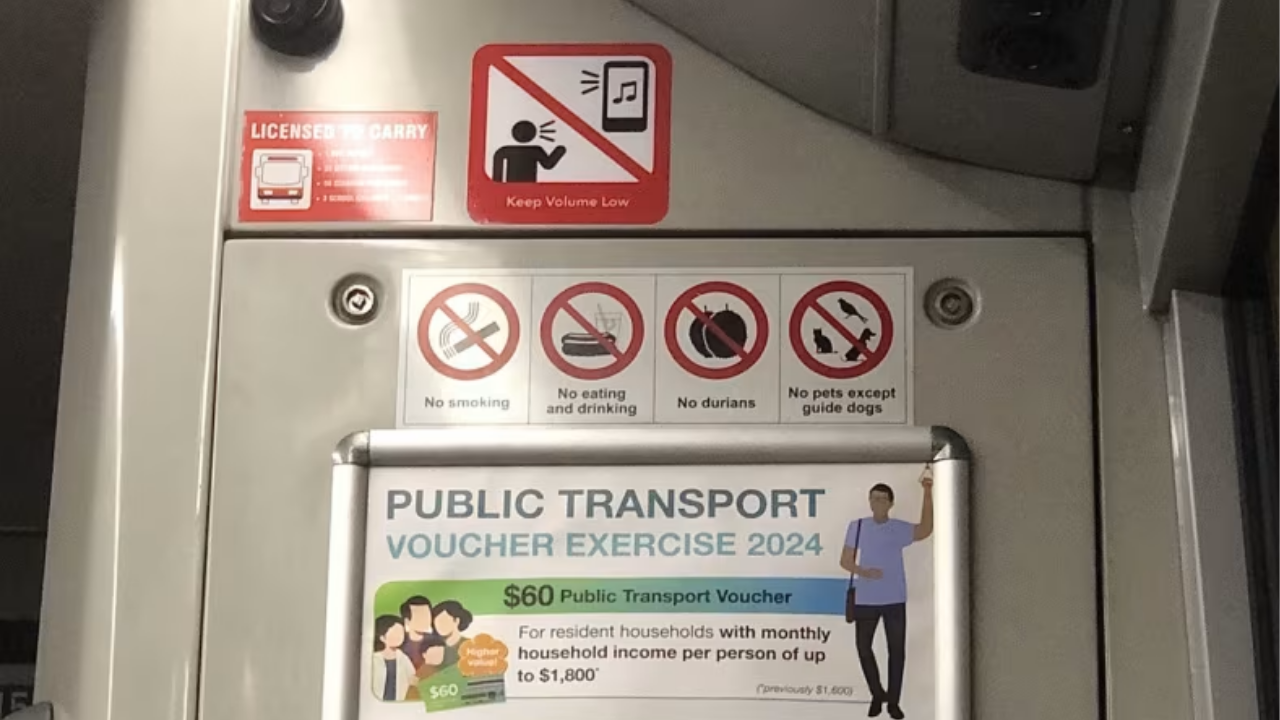
Commuters in Singapore may have noticed new signs on buses and MRT trains asking passengers to be more considerate, a move by the Land Transport Authority (LTA) to make daily commutes more pleasant for everyone.
Since December 2024, signs reminding people to keep their voices down, refrain from sitting on the floor, and avoid taking up more than one seat have been progressively rolled out. Noise-related reminders appear on both trains and buses, while the rest are mainly found on the MRT network.
These efforts appear to be making a difference, at least in terms of enforcement. Between December 2024 and May 2025, over 160 offence notices were issued, four times more than the number handed out in the six months prior.
Those who flout the rules may be fined up to S$500. More serious offences, such as dirtying public transport facilities, can result in penalties of up to S$5,000. In such cases, public transport staff are authorised to ask offenders to leave or contact the police.
Despite the increased enforcement, awareness of the new signs remains low. Out of six commuters interviewed, only one recalled seeing them.
Still, some commuters said they have noticed a change. Retiree Kamaria K, 64, said she observed a stark difference in noise levels compared to two years ago when she was still working. Her daily commute from Yew Tee to Paya Lebar used to be loud and chaotic, but now, she said, “it’s very quiet.”
Jenny Yeo, a 66-year-old administrative executive, echoed this. She shared that she no longer hears loud phone conversations during her regular bus and MRT rides, although her trips tend to be short.
Others were less convinced. Marketing specialist Casey S reported seeing inconsiderate behaviour “almost 90 per cent of the time” during her 30-minute MRT commute, including people blasting videos or music without headphones. Madam Noraizah Ashiraff, 44, an administrative executive, said noise levels tend to rise during off-peak hours, often due to older commuters using their devices loudly. She felt the new signs haven’t been “tremendously” effective and believes more time is needed for habits to change.
Interestingly, none of the commuters interviewed reported seeing others hogging multiple seats. However, a few mentioned spotting students sitting on the train floor, a behaviour they were generally sympathetic about, suggesting the students were likely tired from long journeys.
The new signage is now in place across all SMRT trains, except for the newest R151 models on the North-South and East-West Lines, which will receive them at a later stage. On the SBS Transit network, the signs have been installed on all trains running on the North-East and Downtown Lines.
Bus operator Tower Transit has also taken steps to reinforce commuter etiquette. It has put up 19 “conditions of carriage” signs across its six bus interchanges. These signs remind passengers to behave in an “orderly and decent” manner and to uphold public cleanliness and health standards. Bus drivers are empowered to ask non-compliant passengers to alight or, in serious situations, alert the authorities.
Glenn Lim, Tower Transit’s communications and customer experience director, said the company conducts about 1,800 ticket checks every month. So far, no warnings, fines or offence notices have been issued under the new rules. He added that the company remains committed to working with the authorities and its frontline staff to ensure a safe and respectful environment for all commuters.