
As Singapore prepares to implement the Workplace Fairness legislation, which aims to protect workers from discrimination and retaliation, questions about how safe employees are when they speak up have come into sharper focus.
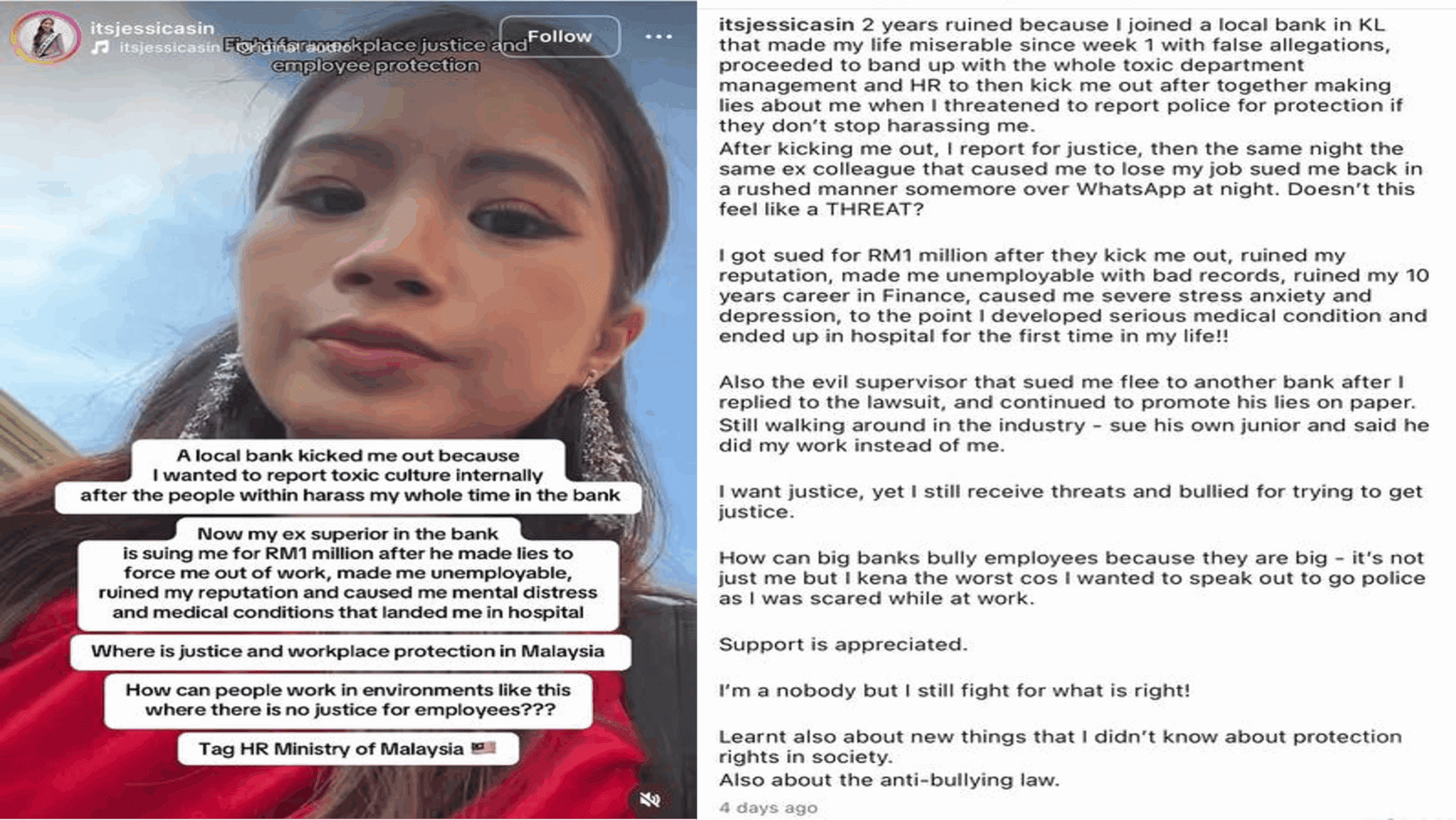
One woman from Malaysia has taken to Instagram to share her experience working at a local bank in Kuala Lumpur, claiming she was forced out after attempting to report what she described as a toxic workplace culture internally.
At the point of writing, her post has garnered 3,870 likes and been shared 261 times, based on the figures shown on the post.
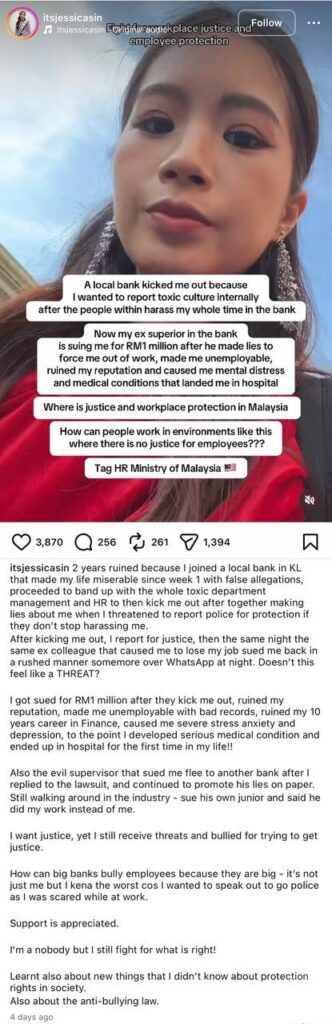
In a video uploaded to her account on Jan 28, she alleged that from her first week at the bank, she faced harassment and false allegations at work. According to her, the situation escalated after she attempted to raise concerns internally, which eventually led to management and human resources dismissing her from her job.
She further claimed that after she was let go, her former superior sued her for RM1 million (~SGD 320,000), accusing him of making false statements that damaged her reputation and left her unemployable in the finance industry. She said the ordeal caused her severe stress, anxiety and depression, and resulted in medical conditions that landed her in the hospital.
In the Instagram caption, she also alleged that on the same night she reported her case in pursuit of justice, a former colleague, whom she said was involved in the incident, contacted her repeatedly over WhatsApp in a rushed manner, which she questioned as a possible threat.
She added that despite the lawsuit and her reply to it, her former supervisor allegedly continued working in the industry and was even promoted, while she continued to face bullying and threats for speaking up.
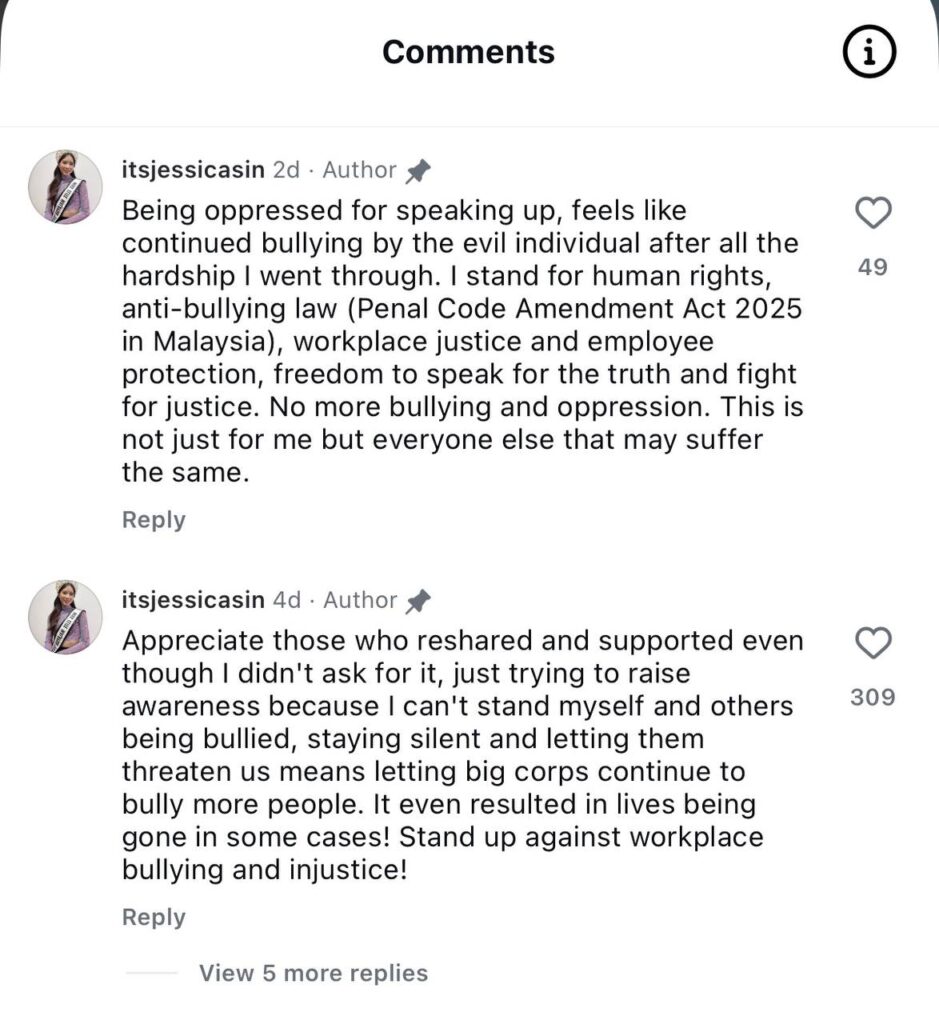
In the comments section of the post, the woman said being “oppressed for speaking up” felt like continued bullying, adding that she was standing up not just for herself but for others who may face similar treatment. She said she believes in human rights, workplace justice and employee protection, as well as freedom to speak up and fight for the truth.
She also referenced what she described as Malaysia’s anti-bullying law under the Penal Code Amendment Act 2025, saying she wanted an end to bullying and oppression in the workplace.
In another comment, she thanked those who reshared and supported her post, saying her intention was to raise awareness rather than seek attention. She added that staying silent allows large corporations to continue bullying employees, and claimed that in some cases, workplace bullying has led to lives being lost.
Through her Instagram post, she questioned how employees in Malaysia can feel safe at work when, in her words, there is little protection for those who speak up. She also called on the Human Resources Ministry of Malaysia to look into her case, adding that she is continuing to seek justice despite describing herself as a “nobody”.
Workplace protection in Malaysia
In Malaysia, employees who believe they were dismissed “without just cause or excuse” can file a representation under Section 20 of the Industrial Relations Act 1967. Such cases are heard by the Industrial Court, which may order remedies such as reinstatement or compensation. Claims must generally be filed within 60 days from the date of dismissal.
Malaysia also has legal provisions addressing sexual harassment at work. Under the Employment Act 1955, employers are required to investigate complaints of sexual harassment and take appropriate action. In addition, the Anti-Sexual Harassment Act 2022 established a dedicated tribunal to hear sexual harassment cases and provide remedies, including compensation. The Act covers harassment in employment and other contexts.
For bullying and harassment, Malaysia does not have a single standalone civil law specifically governing workplace bullying. However, amendments to the Penal Code, which took effect in 2025, introduced criminal offences covering certain forms of bullying and harassment, including repeated harassment, intimidation and online abuse. These provisions focus on criminal liability rather than employment-specific remedies.
As a result, workplace bullying cases in Malaysia are typically addressed through a combination of employment law, harassment legislation, criminal law and internal company processes, depending on the nature of the conduct involved.
Workplace fairness legislation in Singapore
Meanwhile, in Singapore, workplace harassment and discrimination are addressed through employer obligations, Tripartite guidance and legal avenues. Harassment cases may fall under the Protection from Harassment Act, and workers can also seek help through the Ministry of Manpower and Tripartite Alliance channels.
Singapore has also passed the Workplace Fairness legislation, which introduces a formal framework to address workplace discrimination and unfair treatment. The legislation will require employers to put in place proper grievance-handling systems and protect employees from retaliation, giving workers a safer avenue to seek assistance when they face discrimination at work.
The Workplace Fairness legislation came after years of advocacy around fair treatment at work, including efforts by the National Trades Union Congress (NTUC) to strengthen protections for employees and provide clearer avenues for recourse when disputes arise.
NTUC Assistant Secretary-General and Labour MP Yeo Wan Ling has stressed that fairness at work should not be a slogan, but a real safeguard for workers who face discrimination because of gender, age, family responsibilities or caregiving roles.
Through the Workplace Fairness legislation, she says Singapore is building systems that require employers to handle grievances properly and protect staff who raise workplace concerns, while also promoting respect and dignity for all. Fairness, in her view, benefits workers and employers alike and strengthens society as a whole.