
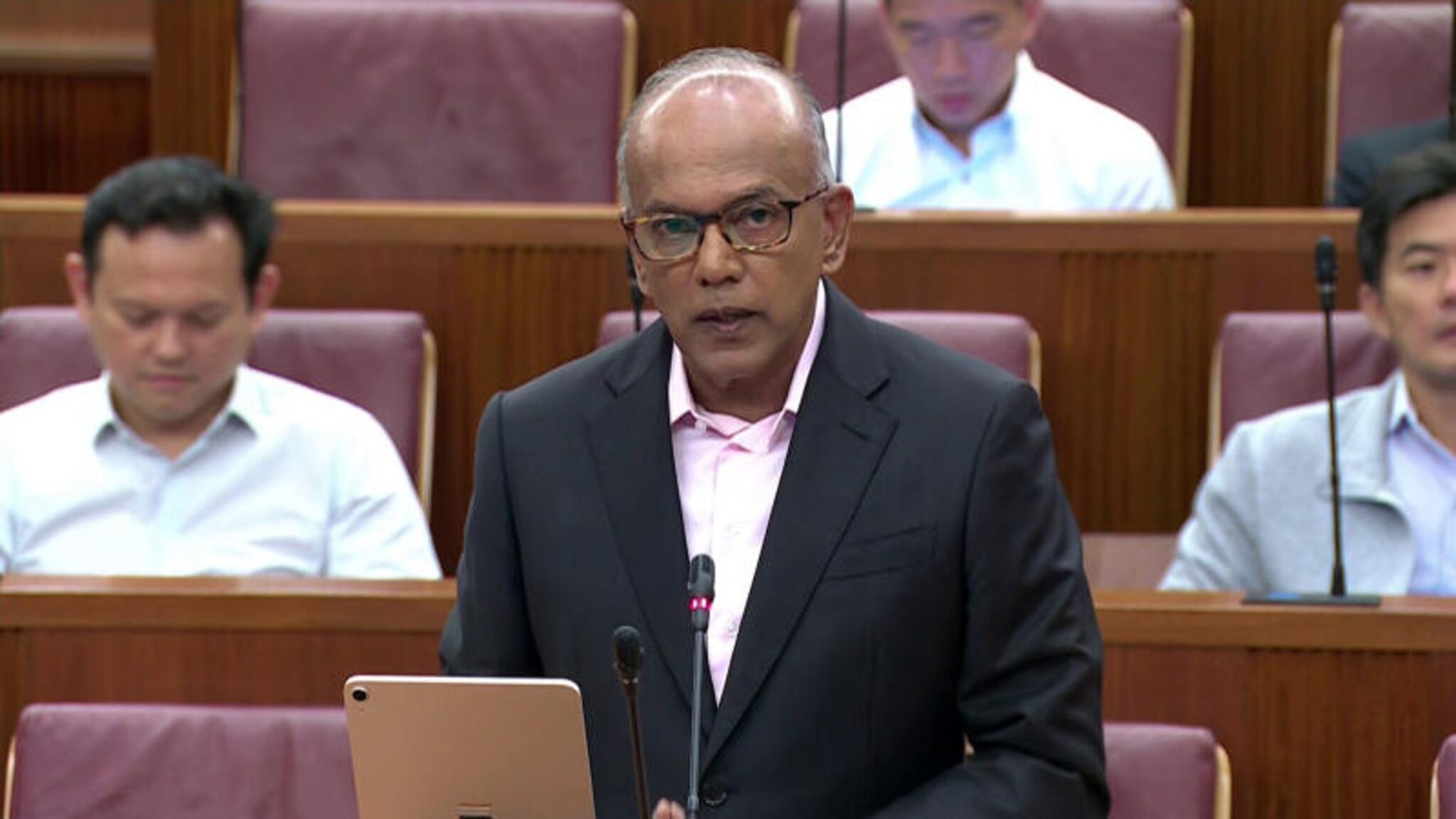
Minister for Home Affairs and Law K Shanmugam said the Workers’ Party (WP) responded too slowly and ambiguously when dealing with an identity politics incident involving race and religion during this year’s General Election. He added that WP also failed to immediately and clearly reject foreign interference and support for their candidate.
Shanmugam made these remarks in Parliament on Tuesday (October 14) in a ministerial statement. He reiterated Singapore’s multiracial and multicultural governance approach and reminded political parties and citizens to firmly reject identity politics.
WP’s delayed response raised doubts
During the May General Election, a Malaysian-based Islamic teacher, Noor Deros, who does not hold Singapore religious qualifications, claimed on social media that the WP took his demands seriously. He urged Muslim voters to support WP and specifically called on voters in Tampines GRC to vote for WP candidate Faishal instead of People’s Action Party (PAP) lead minister Masagos Zulkifli.
The WP later issued a statement clarifying that it had never made any promises, guarantees, or agreements in exchange for political support. It also stressed that religion and politics should not be mixed.
Shanmugam pointed out that WP took more than two days to issue its statement. Every day during an election campaign can affect results, he said, and delaying a response on such a key issue raised doubts and may have led some voters to believe WP was considering Noor Deros’ demands.
He noted that the Ministry of Home Affairs and the Elections Department had to step in to make clear that the situation was unacceptable, and it was only after this that the WP issued its statement.
Statement vague and failed to reject identity politics
Shanmugam also said WP’s statement was not clear enough. It did not explicitly reject Noor Deros’ attempt to mobilise Muslim voters based on race or religion, nor did it reject his support for Faishal.
He gave an example of what a more appropriate response could have been: WP should have clearly said it rejects any attempt to influence Malay Muslim votes on the basis of race or religion, and that it also rejects support for candidates on racial or religious grounds, calling such actions “completely unacceptable.”
He added that WP Secretary-General Pritam Singh had clarified in media interviews on April 26 and 27 that Noor Deros’ support did not mean the party would adopt his demands.
“We hope that in future, political parties will immediately reject any such attempt to interfere in our political process. If this is not done immediately, clearly and unequivocally, it will give rise to questions, confusion,” he said.
Foreign interference: Malaysian PAS overstepped
Shanmugam also highlighted how Malaysia’s Parti Islam Se-Malaysia (PAS) politicians tried to influence Singapore voters during the election by using racial and religious issues, openly supporting WP candidates and criticising PAP’s Malay MPs.
He said PAS is an Islamist party that has long sought to “Islamise Malaysian society.” Its actions, he added, were reminiscent of the period between September 1963 and June 1964, when Singapore was part of Malaysia, when extremist elements stoked communal tensions that eventually led to the 1964 race riots.
Shanmugam said that the events of that period are still deeply remembered by many Singaporeans and stressed that the government must take a firm stand against such actions.
The Ministry of Home Affairs and the Elections Department condemned foreign interference based on racial and religious issues and blocked the relevant posts. Prime Minister Lawrence Wong also stressed that this crossed the red line and called on all political parties to clearly reject foreign involvement.
Drawing the red line on foreign interference
WP issued a statement on April 26 saying it could not control what foreign political parties say, but Shanmugam said the timing and content of the statement were questionable.
Since foreign interference is a serious matter, he said WP should have responded earlier and more clearly, instead of waiting for statements from the Ministry and the Elections Department.
He added that Pritam Singh later told the media and voters during campaign speeches that WP firmly rejects any foreign interference in Singapore’s domestic affairs and does not need foreign support.
Shanmugam noted that this was WP’s clearest position, but said if WP had stated this from the start, it would have better protected the integrity of the election and Singapore’s national position.
SDP’s Damanhuri accused of stoking racial sentiments
Shanmugam also named the Singapore Democratic Party (SDP) candidate for Sembawang GRC, Damanhuri Abas, accusing him of trying to seek support based on race.
He said Damanhuri criticised PAP’s Malay MPs at an SDP event, claiming they did not represent the Malay community or address their concerns. Damanhuri argued that Parliament needed more opposition Malay MPs to speak up for the Malay community and said their problems had not been resolved during 60 years of PAP governance. He urged Malay voters to vote against the PAP, framing it as an issue of upholding Malay dignity.
Shanmugam pointed out that the so-called “dignity” was essentially a euphemism for “Malay rights” and that Damanhuri was promoting racially divisive politics. He criticised this as misleading and said it sacrificed the long-term interests of the Malay community and the nation for short-term political gain, warning it was “a dangerous path” that would trigger a backlash from other communities.
Identity politics would marginalise minority groups
Shanmugam warned that if Singapore were to move towards identity politics, political parties would be incentivised to focus on Chinese voters, leaving minority communities squeezed and marginalised.
He said that appealing to the Malay Muslim vote in this way would deepen fault lines, and if the Malay Muslim community responded, other groups, especially Chinese voters, would also take note of this communal mobilisation and start viewing the Malay community through an ethnic lens.
He said,
“This is what happens in many countries. And our sense is that something like that may have started to happen in Tampines. Many Chinese voters in Tampines seem to have observed the communal nature of the appeals to the Malay voters. And they seem to have chosen to take a different direction, during this GE. But this sort of racial dynamics in politics is very bad for Singapore.”
Religion and politics require respect and restraint
The same dangers apply in the religious sphere. If Christianity, Buddhism or Taoism were to dominate politically, it would provoke unease and resentment among Muslims, Hindus and other groups.
Shanmugam warned that playing to racial or religious emotions through identity politics would lead to division and violence, as history has shown.
He said if party leaders see identity politics taking root, they may succumb to pressure or temptation to follow suit.
“You know what will happen then. It is a one-way street to ruin.”
He emphasised that identity politics can only be contained if mainstream forces, whether the PAP or other parties, reject it outright. If these forces adopt such strategies, more politicians will be drawn in, and society will end up divided and in conflict.
He stressed that while the dangers of politicising race and religion are obvious, this does not mean religion and politics must be completely separated.
Shanmugam explained that religious beliefs inevitably influence people’s worldviews and values, which can overlap with public issues. In a diverse society, however, such expressions must be approached with respect and restraint, adding that while individuals are free to practise their faith and share political views rooted in their beliefs, this must always be done in a way that respects other religions.
Putting Singaporeans first and rejecting divisive politics
Shanmugam said political debate involving religion must be grounded in secular principles and all parties must exercise restraint. No political party should exploit religion for political gain, especially not as an election mobilisation tool.
He stressed that Singapore’s social structure is built on compromise and consensus, with every community making sacrifices for the common good, allowing society to progress together. If any group prioritises only its own interests and ignores others, backlash will follow.
“We must view Singaporean identity as the foundation, and everyone must make some compromises to strengthen our shared Singaporean identity,” he said.
Shanmugam stressed that the government has a duty to act decisively when social cohesion is threatened or when someone tries to bring race and religion into partisan or electoral politics.
“We cannot allow such behaviour to take root in Singapore, because it will corrode the foundations of our democracy and tear apart the fabric of our society,” he said.