
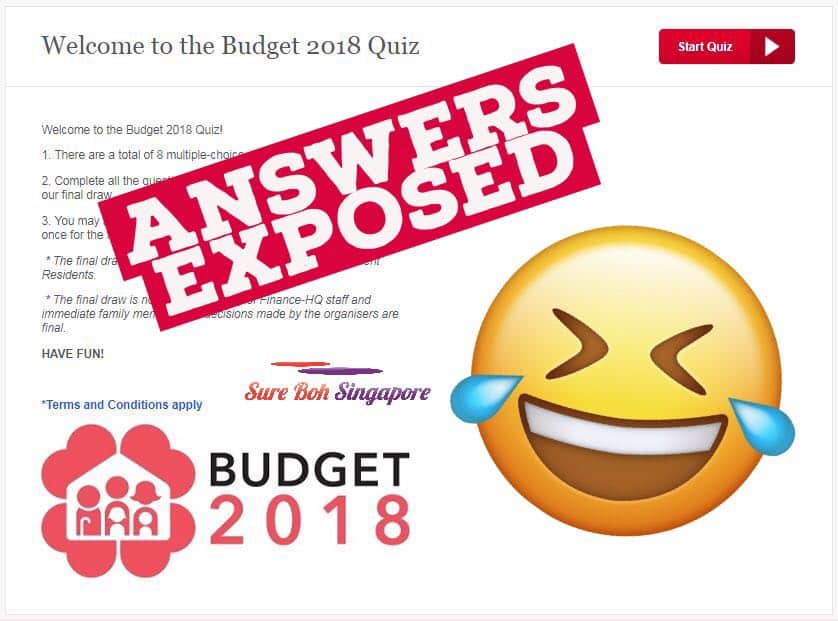
Have you tried the Budget 2018 Quiz? Apparently Ministry of Finance is giving away prize vouchers to all Singaporeans and PRs in their lucky draw.
There are 29 questions listed below but only 8 MCQ will appear in the quiz.
The test is surprisingly quite tough but don’t worry! We’ve done it a few times and copied out all the correct answers for you.
So if you want to qualify for the lucky draw, just follow our cheat sheet below and input all the accurate answers in the quiz.
Budget 2018 Cheat Sheet
1) To support the increase in GST Voucher – U-Save rebates and other future GST Voucher payments, a top-up of $_______ to the GST Voucher Fund was announced at Budget 2017.
Answer: $1.5 billion.
The GST Voucher Fund was established in 2012 to finance payments for the GST Voucher scheme.
2) Which of the following taxes is usually the biggest contributor to the Government’s tax revenue?
Answer: Corporate Income Tax.
Corporate Income Tax accounted for 19.6% of total Government Operating Revenue in FY2016, yielding $13.45 billion.
3) To foster a spirit of giving, donations made to Institutions of a Public Character (IPCs) from 2016 to 2018 will receive a _____ tax deduction.
Answer: 250%.
About tax deduction. To continue building a stronger sense of community, Government has been providing at least 250% tax deductions for qualifying donations since 2009 (refer to table above).
About Institutions of a Public Character (IPCs). Some registered charities are conferred the status of Institutions of a Public Character (IPCs). This allows them to issue tax deductible receipts to donors who want to claim tax relief based on the amount of qualifying donations made.
To qualify as an IPC, the charity must be dedicated to serving the needs of the community in Singapore as a whole and not confined to sectoral interests or groups based on race, belief, or religion. An IPC is also held to a higher standard (than Charities), both in terms of regulatory compliance as well as governance.
There are currently more than 650 IPCs in Singapore.
4) The Government’s Financial Year (FY), or period of accounting, runs from:
Answer: 1 Apr – 31 Mar.
In 1968, Singapore’s Financial Year was adjusted from 1 Jan – 31 Dec to 1 Apr – 31 Mar to provide more time to prepare a proper account of the economy during the preceding calendar year.
5) The Rapid Transit System (RTS) Link between Singapore and Johor Bahru will have direct connectivity to the __________________?
Answer: Thomson-East Coast Line.
The RTS Link will be completed by 2024 to ease congestion at the border crossings, and connects to Woodlands North station on the Thomson-East Coast Line to increase convenience for commuters.
6) Which of these statements about the Small and Medium Enterprises (SMEs) Go Digital programme are true?
I. SMEs can get step-by-step advice on the technologies to use at each stage of growth.
II. SMEs can get in-person help on pre-approved digital solutions at SME Centres and on more advanced digital needs such as data analytics at the SME Digital Tech Hub.
III. SMEs that propose to pilot emerging ICT solutions can receive advice and funding support.
IV. It helps SMEs build stronger digital capabilities to seize opportunities for growth.
Answer: All of the above.
The SMEs Go Digital programme aims to help SMEs use digital technologies, build strong digital capabilities and participate in the Digital Economy. SMEs can approach SME Centres for advice on pre-approved solutions, and those with more advanced digital needs would be referred to the SME Digital Tech Hub. The SME Digital Tech Hub is located at APEX@Henderson.
7) Since 2011, how many new hawker centres has the Government committed to build by 2027?
Answer: 20.
The Government announced in 2011 that it will build 20 new hawker centres by 2027 to provide affordable cooked food options, especially in towns with lower cooked food provision, such as Bidadari, Bukit Panjang and Sengkang. As at end 2017, seven new hawker centres have been built in Hougang, Bukit Panjang, Tampines, Admiralty, Yishun, Pasir Ris and Jurong West.
8) At Budget 2015, the marginal personal income tax rate for the highest income earners was increased from ____% to ____%.
Answer: 20, 22.
At Budget 2015, the marginal personal income tax rate was increased from 20% to 22% for the highest income earners with a chargeable income above $320,000.
9) How many individuals have served as Singapore’s Minister for Finance since independence in 1965?
Answer: 8.
Do you recall all 8 of them? Here are their names:
1965-1967: Lim Kim San
1967-1970: Dr Goh Keng Swee
1970-1983: Hon Sui Sen
1983-1985: Dr Tony Tan
1985-2001: Dr Richard Hu
2001-2007: Lee Hsien Loong
2007-2015: Tharman Shanmugaratnam
2015-present: Heng Swee Keat
10) Which of the following is NOT a reason why the Government is not in a position to disclose the overall size of Singapore’s reserves?
Answer: “It takes too much time and effort to value all of our overseas assets” is NOT a reason why.
Our reserves are a critical resource for Singapore’s future. As a strategic asset, our reserves serve two key purposes:
They provide a key defence for Singapore in times of crisis, allowing us to mount a decisive and effective response.
The investment of our reserves also provides a valuable stream of income for the Government Budget, which can be spent or invested for the benefit of current as well as future generations.
11) How is it possible that the Singapore Government has no net debt despite its high gross debt levels?
Answer: The Singapore Government has a strong balance sheet, with assets well in excess of its liabilities.
Taking into account our assets, Singapore has no net debt.
12) SGSecure is a national movement to sensitise, train and mobilise the community to play a part to prevent and deal with a terrorist attack. What are the three things one should do if caught in a terrorist attack?
Answer: Run, Hide, Tell.
In the rare event of a firearms or weapons attack:
- RUN away from danger. Do not surrender or attempt to negotiate.
- If escape is not possible, HIDE. Find cover and stay out of sight. Be very quiet and switch your phone to silent mode.
- When it is safe to do so, TELL the police. Call 999 or SMS 71999 if it is not safe to talk. Provide details on your location and the attackers. You may also use the SGSecure app to provide information to the authorities.
13) The Government’s Revenue and Expenditure Estimates report contains information on:
I. Revised government revenue estimates for the current financial year
II. Revised expenditure estimates for the current financial year
III. Estimated government revenue for the upcoming financial year
IV. Planned expenditure for the upcoming financial year
Answer: All of the above.
The Revenue and Expenditure Estimates report contains the revised revenue and expenditure estimates for the current financial year, as well as the estimated revenue and expenditure for the upcoming financial year.
14) What housing grants are available to first-timer applicants for resale flats?
I. Proximity Housing Grant (PHG)
II. Parenthood Provisional Housing Grant (PPHG)
III. First Steps Housing Grant (FSHG)
IV. Family Grant
V. Additional CPF Housing Grant (AHG)
VI. Silver CPF Housing Grant (SHG)
Answer: I, IV and V.
Eligible first-timer families buying an HDB resale flat can enjoy up to $110,000 in housing grants.
This consists of:
1. Family Grant of up to $50,000 (depending on flat type)
2. Additional CPF Housing Grant (AHG) of up to $40,000 (depending on income)
3. Proximity Housing Grant (PHG) of $20,000, for living with or near parents or married child(ren)
15) In FY2017, where did the Government allocate the bulk of its expenditure to?
Answer: Social Development.
Expenditure on Social Development for FY2017 was estimated at $37,752m, or 50.3% of the estimated FY2017 total expenditure.
16) The Cultural Matching Fund (CMF) was announced in Budget 2017, with a $150m top-up. Which of the following statements about CMF is NOT true?
Answer: “CMF provides 5:1 matching for every dollar donated to the cultural sector” is NOT true.
Donations to the Arts/Heritage sector has more than doubled since CMF was introduced in 2014. Please refer to the chart above.
17) To support the increase in GST Voucher – U-Save rebates and other future GST Voucher payments, a top-up of $_______ to the GST Voucher Fund was announced at Budget 2017.
Answer: $1.5 billion.
The GST Voucher Fund was established in 2012 to finance payments for the GST Voucher scheme.
18) Which of the following programmes aims to improve access to Intellectual Property (IP) for Small and Medium Enterprises (SMEs)?
Answer: Headstart programme.
The Headstart programme allows Small and Medium Enterprises that co-develop IP with A*STAR to enjoy royalty-free and exclusive licences for 36 months in the first instance.
19) Government spending on healthcare has increased over the years. In 2010, the Ministry of Health’s budget was $4 billion. What was its budget in 2016?
Answer: $10 billion.
As Singaporeans live longer, and our population ages, we will need to spend more on healthcare. The Ministry of Health’s budget will increase even further in the coming years, and is expected to reach more than $13 billion in 2020!
20) The Net Investment Returns Contribution (NIRC) provided around ____ of Singapore’s Gross Domestic Product (GDP) in the FY2017 budget.
Answer: 3%.
The Net Investment Returns Contribution (NIRC) comprises:
- Up to 50% of the Net Investment Returns on the net assets invested by GIC, MAS and Temasek; and
- Up to 50% of the Net Investment Income derived from past reserves from the remaining assets.
21) When is Budget Day 2018?
Answer: 19 Feb.
The Singapore Budget will be presented by Minister for Finance Heng Swee Keat in Parliament on Monday, 19 February 2018.
22) What fund under the Constitution provides for urgent and unforeseen needs that were not adequately provisioned for under the Supply Bill?
Answer: Contingencies Fund.
Under the Constitution, the Minister for Finance may make advances from the Contingencies Fund to provide for Ministries’ urgent and unforeseen spending needs which were not adequately provisioned for under the Supply Bill.
23) Which of the following statements about the Professional Conversion Programmes (PCPs) is false?
Answer: “PCPs are available in less than 10 sectors” is FALSE.
There are currently over 50 PCPs across more than 20 sectors. PCPs are career conversion programmes to help job seekers undergo skills conversion and move into new occupations or sectors that have good prospects and opportunities for progression.
24) By 2030, all HDB towns will have a cycling network. Along with other cycling networks, there would be a total of ____km of cycling paths across the island.
Answer: 700km.
The 700km of cycling paths consist of intra-town routes, inter-town routes, the Park Connector Network and the Round Island Route. Other bicycle-friendly infrastructure such as bicycle crossings and bicycle parking facilities will also be added to encourage a cycling culture.
25) In FY2017, the Government’s total expenditure by Ministries is estimated to be about ___ of Singapore’s Gross Domestic Product (GDP).
Answer: 17.7%.
The Government’s total expenditure by Ministries was estimated to be $75,072m, or 17.7% of Singapore’s Gross Domestic Product (GDP).
26) Which Ministry is estimated to have the 4th highest expenditure in FY2017?
Answer: Ministry of Transport
Top 4 Ministries by Total Expenditure (Estimated FY2017):
- Ministry of Defence – $14,207m
- Ministry of Education – $12,900m
- Ministry of Health – $10,735m
- Ministry of Transport – $9,166m
27) Why do we have the GST Voucher scheme?
Answer: To provide assistance to less well-off Singaporeans to offset some of the impact of GST paid on daily expenses.
As lower-income families consume most, if not all, of their disposable income, the GST imposes a higher burden on them compared to those with higher income.
The GST Voucher (GSTV) Scheme was introduced as a permanent scheme in 2012 to provide continuing assurance that the GST will not disproportionately affect those who are less well-off. It is part of a progressive system of taxes and transfers, which ensures that the lower income get back more benefits than the total taxes they pay.
It provides assistance in 3 components:
1. Cash: Lower-income citizens can receive cash payouts for their daily expenses
2. Medisave: Elderly citizens can receive Medisave top-ups to their CPF accounts to help them with healthcare expenses
3. Utilities rebates (U-Save): Lower- and middle- income households can receive rebates on their utilities bills
28) What is the approval process for the Government to spend in the FY?
I. The Minister for Finance presents the Budget bill to Parliament
II. Cabinet approves the Budget
III. Parliament passes the Supply Bill
IV. Parliament holds a Budget debate
V. The President’s assent is sought for enactment of the Supply Bill
Answer: II, I, IV, III, V.
The Budget needs to be approved by Cabinet before it can be presented to Parliament. After Parliament has passed the Supply Bill, President’s assent is required before the Supply Bill can be enacted as law.
29) The Singapore Government strives to maintain a balanced budget over each term of government. Which of the following does not refer to a balanced budget?
Answer: “The Government spends more money than the amount collected” is NOT an example of a balanced budget.
To maintain a balanced budget, a government would have to at least collect as much money as it spends, or collect more money than it spends.
You’re welcome.
If you’d like to contribute your story to us, drop us an email at editors@wordpress-1230300-5974443.cloudwaysapps.com and we’ll review it. We read each submission that comes to us within two weeks of receiving it.